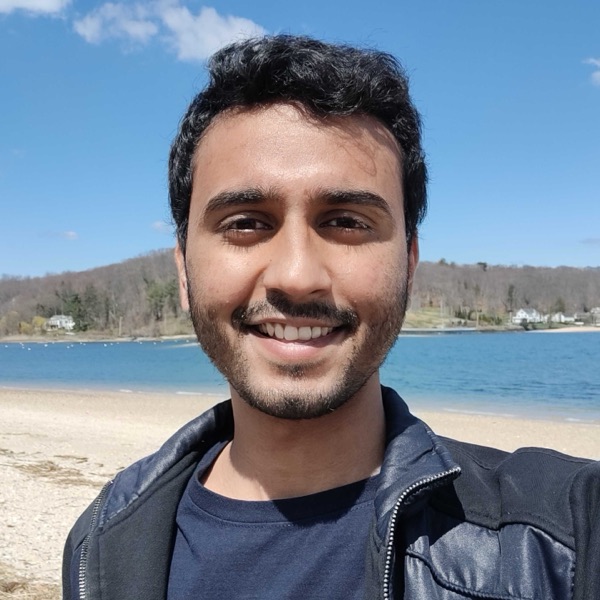
Shivang Rawat
AI Research Scientist, The Sequel Institute (Telepath), New York
I study how recurrent neural networks, biological and artificial, can stay stable, learn efficiently and keep learning over time. My work draws on dynamical systems, stability theory and stochastic processes.
I received my Ph.D. in Mathematics from the Courant Institute at New York University in 2025, advised by Prof. Stefano Martiniani. Before that, I studied chemical engineering at the University of Minnesota (M.S.) and IIT Roorkee (B.Tech.).
Research
I develop theory for recurrent computation in brains and machines. A recurring theme is divisive normalization: it keeps recurrent circuits stable even when their recurrent weights are strong, and it shapes how cortical areas communicate. I also study how deep continuous-time networks learn, and how long timescales emerge in stochastic neural dynamics.
- Continual learning
- Recurrent neural networks & state space models
- Biologically plausible learning
- Dynamical systems & stability theory
- Stochastic processes & spectral analysis
Publications
-
NeurIPS 2026
Prospective Coding Improves Learning in Deep Continuous-Time Recurrent Networks
Advances in Neural Information Processing Systems (NeurIPS), 2026 Spotlight
Introduces Recursive Quadrature Filters and a parameter-free prospective input update that mitigates depth-dependent gradient attenuation in deep continuous-time recurrent networks and state space models.
-
PNAS 2026
Stabilization of recurrent neural networks through divisive normalization
Proceedings of the National Academy of Sciences, 123(30), e2601841123, 2026
Divisive normalization keeps an arbitrary recurrent network stable even when the spectral radius of its recurrent weights exceeds 1, and the breakdown of normalization coincides with the critical slowing down that precedes instability.
-
eLife 2026
Hierarchical Neural Circuit Theory of Normalization and Inter-areal Communication
eLife, 111297.1, 2026
A hierarchical circuit theory with feedback that implements divisive normalization across cortical areas and accounts for observed power and coherence spectra and low-dimensional communication subspaces.
-
NeurIPS 2024
Unconditional stability of a recurrent neural circuit implementing divisive normalization
Advances in Neural Information Processing Systems (NeurIPS), 37, 14712–14750, 2024
Links divisive normalization to the stability of ORGaNICs, a biologically plausible cortical circuit model, so that it can be trained with backpropagation through time without gradient clipping.
-
PRR 2024
Element-wise and recursive solutions for the power spectral density of biological stochastic dynamical systems at fixed points
Physical Review Research, 6(4), 043179, 2024
Inverse-free, element-wise and recursive solutions for the noise power spectral density of stochastic linear systems, illustrated on models from neuroscience and evolutionary game theory.
Preprints
-
arXiv 2026
A minimal mechanism to generate long timescales without fine tuning
arXiv:2608.21586, 2026
A dynamical feedback gain lets a linear recurrent network self-organize to the edge of stability, so long timescales and scale-free correlations arise without fine tuning.
-
arXiv 2026
Exact Variance and Fano Factor for Arbitrary Level Crossings in Stationary Gaussian Processes
arXiv:2605.25278, 2026
Exact formulas for the variance and Fano factor of level crossings in smooth stationary Gaussian processes, going beyond the Kac–Rice mean rate to show when crossings cluster or become regular.
Thesis
-
Ph.D. 2025
Divisive Normalization as a Mechanism for Stable and Efficient Recurrent Neural Computation
Ph.D. thesis, Courant Institute of Mathematical Sciences, New York University, 2025
* Equal contribution
Talks & posters
-
2025
Unconditional stability of a recurrent neural circuit implementing divisive normalization
-
2024
A comprehensive large-scale model of primary visual cortex (V1)
-
2023
Coherence influences the dimensionality of communication subspaces
-
2023
Theory of communication for stochastic recurrent neural networks
-
2022
A simple theory of stochastic dynamics near stable fixed points
-
2021
Generalized ORGaNICs: Towards a Unifying Framework for Neural Dynamics
-
2020–22
Generalized ORGaNICs, resonance in stochastic models of cortical circuits, and spectral analysis of normalization circuits
Honors & awards
- 2025
Wilhelm T. Magnus Memorial Prize, for significant contributions to mathematical sciences
- 2024
APS DBIO Travel Award
- 2022
MacCracken Fellowship, New York University
- 2019
Arnie Fredrickson Fellowship, University of Minnesota
- 2018
DAAD-WISE Scholarship for an undergraduate summer internship
- 2015
KVPY (Kishore Vaigyanik Protsahan Yojana) Scholar
Service
- 2027
Reviewer, ICLR
- 2025–26
Reviewer, NeurIPS